No Name, No Recording, No Warning: The Strange Magic of a Brand New Song Dropped Mid-Tour
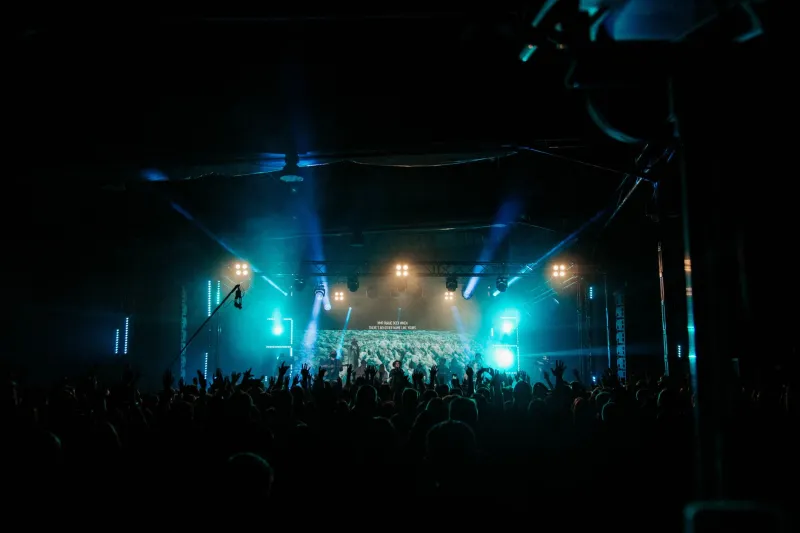
There's a particular kind of stillness that falls over a crowd when something unfamiliar starts coming through the speakers. Not confusion exactly — more like collective attention sharpening all at once. The groove is real, the melody is landing, but nobody can place it. Phones come out. Fingers hover over keyboards. People turn to each other with that look: have you heard this before?
They haven't. Nobody has. The band just started playing something that didn't exist in any public form until about forty-five seconds ago.
Welcome to one of jam culture's most quietly electric traditions: the mid-tour debut of a song that has no name, no release, and no prior existence outside of a rehearsal room or a late-night hotel room idea. Call it the phantom setlist moment. Call it a ghost track in real time. Whatever you call it, if you've ever witnessed one, you know it hits different.
Born on the Road, Not in the Studio
There's a reason bands tend to workshop new material on tour rather than waiting for a proper studio session. The road has a way of stress-testing songs that no rehearsal space can replicate. You've got a couple hundred people in front of you who have no idea what's coming, and that energy — that genuine, uncoached reaction — tells a band more in three minutes than months of practice ever could.
Musicians who've been through this process describe it almost like field research. You have a rough idea at soundcheck, maybe a chord progression and a loose melody, and then you throw it into the set somewhere in the second half when the room is already warm. The crowd's response becomes part of the composition process. Did the bridge land? Did the energy sag in the wrong spot? Did people lean in or drift away?
Some songs survive that first exposure and get sharper with each outing. Others quietly disappear, never played again, living only in the memories of whoever happened to be in that room on that particular Tuesday night in Columbus or Baton Rouge.
The Fan Side of the Mystery
For dedicated followers who track setlists with near-religious precision, an unidentified song is both a gift and a puzzle that has no guaranteed solution. The taping community — those patient, committed souls who capture live shows on recording equipment and share the results across fan networks — will often have a version of the performance circulating within hours. But what do you call it?
Untitled songs accumulate placeholder names that range from poetic to absurd. They get named after the city where they debuted, after a lyrical fragment someone caught on tape, after the date, or sometimes after whatever the person who uploaded the recording felt like typing at two in the morning. A song might circulate for months under three different fan-assigned titles before the band ever officially acknowledges it exists.
That ambiguity is part of the appeal. Fans who were present for the first performance carry a kind of bragging right that no streaming service can ever commodify. You were there. You heard it first. You sat with the uncertainty and the excitement and the communal confusion of experiencing something genuinely new.
What Bands Are Actually Testing
It's worth understanding what's really happening when a band decides to drop an unreleased piece into a live set. It's rarely impulsive in the way it might appear from the audience. Most touring musicians are running a quiet internal evaluation process throughout a run of shows, and the live debut is just one stage of it.
Bands are listening for how a new song breathes in a real room — whether the dynamics feel right at volume, whether the transitions work when adrenaline is involved, whether the lyrics (if there are any) actually connect or just sort of float past without catching. Studio recordings are controlled environments. Live rooms are honest ones.
There's also the question of placement. Where a new song sits in a set says a lot about how the band is thinking about it. Tucked into a mid-set run, it can stretch and develop without the pressure of an opener or closer. Dropped as a second-set centerpiece, it becomes a statement. Played as a late encore surprise, it feels like a secret shared between the band and whoever stuck around.
When the Crowd Becomes a Collaborator
One of the stranger and more beautiful aspects of this tradition is how audience energy can actually shape an unfinished song. Bands have talked about moments where a crowd's reaction to a particular section led them to expand it, lean into it harder, or rethink it entirely before the next show. The applause — or the silence — carries information.
This is the part of jam culture that doesn't translate well to people who've never experienced it. It's not just about musical improvisation. It's about a genuine feedback loop between performers and audience that has real consequences for what the music eventually becomes. You're not just watching a band play. You're participating, however passively, in the construction of something.
Some of the most beloved songs in jam band catalogs started as nameless experiments dropped into mid-tour sets with no announcement and no explanation. The band played something raw and unfinished, the crowd responded, and over the following weeks or months it got refined into something permanent.
The Ones That Got Away
Not every phantom setlist moment leads somewhere. For every unnamed song that eventually finds its way onto a record or into the regular rotation, there are probably five that simply vanished. One performance, maybe two, and then nothing. The band moved on. The song didn't survive the road.
Those ghost tracks have their own mythology in the fan community. Bootleg recordings get passed around like artifacts. People debate whether a particular version from a 2019 show in Denver was actually the same composition as something played once in Asheville two years earlier. Without official documentation, everything is speculation and memory and the occasional shaky phone recording taken from the back of a sweaty club.
There's something kind of perfect about that, honestly. Not everything is meant to be finished. Not every song needs a title or a release date or a Spotify page. Some music exists only in a specific moment, in a specific room, for the specific people who happened to show up that night.
Why It Matters
In an era when nearly everything is documented, catalogued, and algorithmically served back to you, the phantom setlist moment is one of the last genuinely wild things in popular music. You can't prepare for it. You can't stream it later. You can only be there or not be there.
That's the whole point of getting in the car, driving four hours, and standing in a room with strangers who care about the same band you care about. You're buying a ticket to something that might be completely ordinary, or might turn out to be the first time in human history that a particular piece of music exists outside of someone's head.
The jar stays sealed until the band decides to open it. And sometimes what comes out is something nobody knew was in there — including the people who made it.