Five People and a Bartender: What Jam Bands Learn When Nobody Shows Up
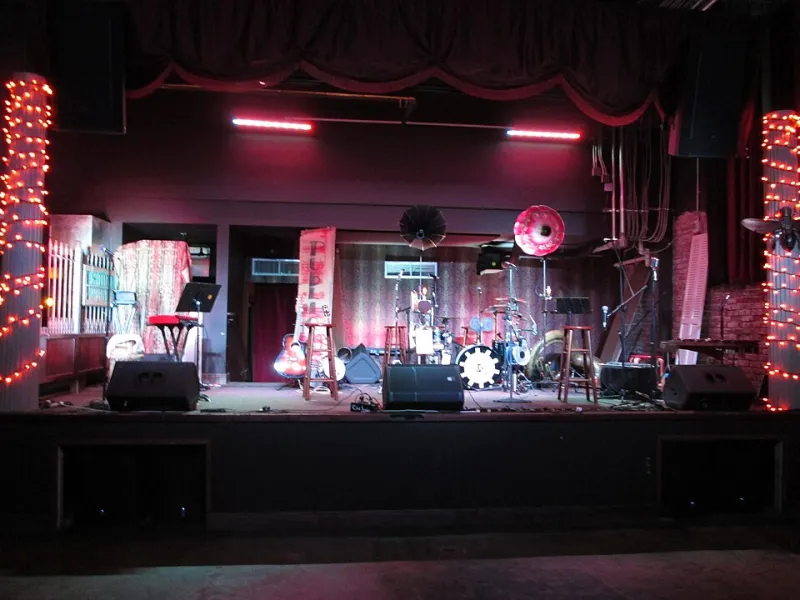
Photo: Infrogmation of New Orleans, CC BY-SA 3.0, via Wikimedia Commons
There's a particular kind of quiet that settles over a venue when the crowd doesn't come. Not the comfortable pre-show hush before doors open, but the specific, hollow silence of a room that was supposed to be full and just... isn't. The sound guy checks his levels twice. The bartender wipes down the same section of bar for the third time. Somebody in the band makes a joke that doesn't quite land. And then, eventually, you play anyway.
Every touring musician who's spent real time on the road has a night like this tucked somewhere in their back pocket. The gig that sold eleven tickets. The Thursday in Tulsa where the weather turned and everyone stayed home. The venue that booked you in a 300-cap room when a 40-cap room was probably already optimistic. These are the ghost gigs — the shows that haunt you not because they were disasters, but because of what they quietly asked you to answer about yourself.
The Night the Room Didn't Fill
Marcus Delray, guitarist for the Georgia-based outfit River Lung, remembers a February show in Columbus, Ohio like it happened last week. "We'd driven eight hours. There were maybe six people when we started, and I think two of them were just waiting out the cold." He laughs, but there's something real underneath it. "We'd been building momentum for months. That night felt like the road just reached up and slapped us."
It's a story that repeats across the jam band world with remarkable consistency. The details shift — different cities, different seasons, different numbers — but the emotional architecture stays the same. There's the arrival, the load-in, the dawning realization that something's off. Then the decision point: what kind of band are you going to be tonight?
For many musicians, that question cuts deeper than any sold-out show ever could.
What You Do When There's No Crowd to Hide Behind
Here's the thing about playing to a packed house: the energy in the room carries you. The crowd feeds back into the performance, and the performance feeds back into the crowd. It's a loop, and it's intoxicating. But play to eight people on a Wednesday night in a bar that smells like old carpet, and that loop disappears. What's left is just you, your bandmates, and whatever you actually brought to the stage.
Sophia Trent, fiddle player for the Vermont-based collective Mudline, puts it plainly. "Low-turnout shows strip everything down. You can't hide behind momentum. If you're phoning it in, everyone in that room — all twelve of them — can see it on your face."
She describes a show in rural Tennessee where the crowd peaked at nine people, including the sound engineer and the opener who'd already packed up their gear. "We played one of the best sets of that tour. I don't know why exactly. Maybe we had nothing to lose. Maybe we were just tired enough to stop overthinking it." She pauses. "One of those nine people found us online three months later. She'd driven four hours to see us at a festival. That's not nothing."
The Morale Problem Nobody Talks About
Keeping a band's spirits intact after a ghost gig is a skill that doesn't get nearly enough credit. There's no handbook for it. Nobody teaches you in music school how to sit in a van at midnight, staring at the highway, after playing your heart out for a handful of strangers who clapped politely and left before the encore.
The bands that survive long tours tend to develop rituals around these nights. Some make a rule: no talking about the crowd size until the next morning. Others lean into dark humor, turning the empty room into a running joke that builds camaraderie instead of resentment. A few musicians described something close to a debrief — an honest conversation about what worked musically, completely divorced from the attendance number.
"We used to do this thing where we'd rate the show on a one-to-ten scale, but crowd size wasn't allowed to factor in," says Delray. "Like, was the playing good? Did we take any risks? Did we connect with each other? Those were the only questions that mattered. It sounds kind of precious when I say it out loud, but it genuinely saved us from spiraling after bad nights."
The Unexpected Gifts
Ask touring musicians about their most meaningful fan interactions, and a disproportionate number of those stories start with a nearly empty room. There's something about low attendance that changes the geometry of the night. The distance between stage and audience collapses. Conversations happen that never would in a crowded venue. People who drove an hour to see a show they heard about through a friend end up talking to the band for forty-five minutes after the last song.
"I've had people tell me things at those small shows that I still think about years later," says Trent. "One guy told me our music was the first thing he'd listened to after his mom died. We were playing to maybe fifteen people that night. I don't think that conversation happens in a full room."
There's also the matter of discovery. More than a few bands credit a ghost gig with connecting them to a local promoter, a booking agent, or a musician who became a long-term collaborator. The empty room has a way of surfacing the people who are genuinely paying attention.
Redefining the Win
The broader jam band community has always had a complicated relationship with conventional metrics of success. Streaming numbers and ticket sales matter, sure — they're what keep the van running and the gear from going to the pawnshop — but they've never been the whole story. The culture has always made room for a different kind of accounting.
A ghost gig, looked at from the right angle, is a stress test. It asks whether the music exists because of the crowd or in spite of the circumstances. For bands that keep showing up — night after night, empty room or full — the answer tends to be the same. The playing is the point. The road is the point. The rest is just weather.
Delray sums it up the way only someone who's lived it really can. "I used to dread those nights. Now I almost look forward to them, in a weird way. They remind you why you started. Nobody's there to impress. It's just the music, honest as it gets."
Somewhere out there tonight, a band is loading into a venue where the walk-in count is going to be brutal. They know it already — you can feel that kind of night before it happens. But they'll tune up, they'll count in, and they'll play like the room is full. Because that's what you do. That's always been what you do.