Don't Touch the Driver's Seat Snacks: The Real Code of Conduct That Holds Touring Bands Together
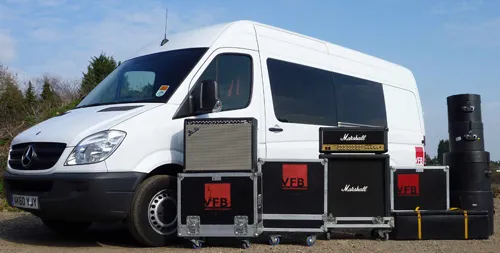
Photo: touring band loading van with music equipment road trip, via api.theunsignedguide.com
There's no employee handbook for being in a touring band. No HR department to file a complaint with when your bassist eats your last granola bar somewhere outside of Amarillo. What there is, though, is a deeply felt, quietly enforced set of rules that every road-seasoned musician seems to carry around like muscle memory. Break them, and you might not hear about it directly — but you'll feel it somewhere between Columbus and Cincinnati, in the silence that settles over the van like a weather system.
We talked to musicians who've logged years on the road — some with nationally recognized jam acts, others grinding through regional circuits on sheer stubbornness — and asked them to put words to what usually goes unsaid. What came back was a living document of road wisdom, equal parts practical and philosophical.
The Van Is a Democracy (Except When It Isn't)
The vehicle is the most intimate space a touring band shares. It's bedroom, break room, and boardroom all in one. And like any shared space, it runs on a set of social agreements that aren't posted anywhere but are understood by everyone.
"Whoever's driving controls the music. Full stop," says Marcus Webb, a keyboard player who's toured the Southeast for over a decade with multiple outfits. "That's the one rule that never gets debated. You're asking someone to stay alert for four hours — you don't get to argue about their playlist."
Beyond the audio hierarchy, sleeping arrangements in the van tend to self-organize based on seniority and physical necessity. Taller musicians get the stretch spots. The person who drove last gets dibs on the back row. Nobody takes the front passenger seat — the "shotgun seat" — for sleeping unless the driver explicitly needs the company. These aren't written anywhere. They just are.
Merch and gear storage in the van follows its own logic too. Band equipment goes in first, personal bags last. If your duffel is getting in the way of a guitar case, your duffel moves. No discussion needed.
Handle Someone Else's Gear Like It's Made of Glass
Few violations on the road generate as much quiet resentment as mishandling another musician's instrument. You learn this early or you learn it the hard way.
"I watched a guitar tech — not even a band member — drop a vintage hollow-body once during load-out," recalls Dani Ruiz, a touring bassist based out of Austin. "The guitarist didn't say a word. He just picked it up, checked the neck, and that was that. But that tech was never on another load-out again."
The etiquette around gear is both practical and deeply personal. Instruments are extensions of the people who play them. Asking before you touch something, always using two hands, never resting anything on top of a case — these are the fundamentals. But the deeper rule is about respect for what that instrument represents to its owner.
Amplifiers are communal in a pinch, but you always ask. You never borrow a pedal board without permission. And if something breaks while it's in your hands, you say so immediately and you offer to fix it. Silence is the worst option.
Money Talks, But the Road Has Its Own Math
Splitting income on tour is where the most elaborate unspoken systems emerge. Guarantees from venues, merch revenue, and tip jars all move through bands differently depending on their internal culture — and the rules governing each stream can be wildly different.
"Our guarantee gets split evenly, always," says Trevor Okafor, who plays guitar in a Midwestern jam quartet that tours nationally. "But merch is different. The person who designed the shirt gets a cut off the top. That's just fair. Creative labor deserves credit."
For many bands, the merch table is its own micro-economy with its own justice system. Whoever's working the table at the end of the night counts the cash in front of at least one other band member. Not because anyone's accused of anything — but because transparency prevents the kind of low-grade suspicion that can quietly corrode trust over a long tour.
Expenses get logged, even informally. Gas, food, lodging — someone tracks it. It might be a note in a phone or a scrawl in a pocket notebook, but the accounting exists. When it doesn't, resentment tends to fill the gap.
Creative Fights Have Rules Too
Every band argues. The ones that survive long enough to matter have figured out how to argue well — or at least how to argue within limits.
The road has its own statute of limitations on creative disputes. You don't relitigate last night's set after a long drive. You don't bring up that one song arrangement when everyone's exhausted and hungry. There's a time and a place, and experienced road musicians know the difference.
"We have a rule: no serious band conversations in the first hour after a show or in the last hour before one," says Ruiz. "Post-show, everyone's adrenaline is still running. Pre-show, everyone's nervous. Neither is a good time to talk about changing the set list."
Disagreements about direction — musical, logistical, financial — get tabled until the band is fed, rested, and in a neutral space. A diner booth works better than a van seat. Daylight works better than 2 a.m.
And when the argument happens, the unspoken rule is that it stays in the room. You don't air band grievances to venue staff, to fans, or on social media while you're still on the road. The road is long and the scene is small.
The Stuff That Never Gets Said Out Loud
Beyond the practical codes, there's a softer layer of road etiquette that's harder to articulate. It's about reading the room in a space that is constantly, relentlessly shared.
You notice when someone needs quiet and you give it to them. You don't push conversation on a bandmate who's staring out the window with headphones on. You offer your last phone charger before someone has to ask. You buy the coffee when it's your turn, and you remember whose turn it is.
"You spend more time with these people than you do with your family," says Webb. "You learn their moods. You learn when to be funny and when to just shut up. That's not a rule anybody taught me. You just pick it up."
The bands that last — the ones you see still playing festivals a decade after their first tour — aren't necessarily the most talented. They're the ones who figured out how to be in the van together without losing their minds. They learned the code, written or not, and they live by it.
Every mile is a negotiation. The road doesn't care how good your music is. It only asks whether you can hold it together long enough to play the next show.