Who's Really Calling the Shots: The Invisible Tug-of-War Between Jam Bands and Their Crowds
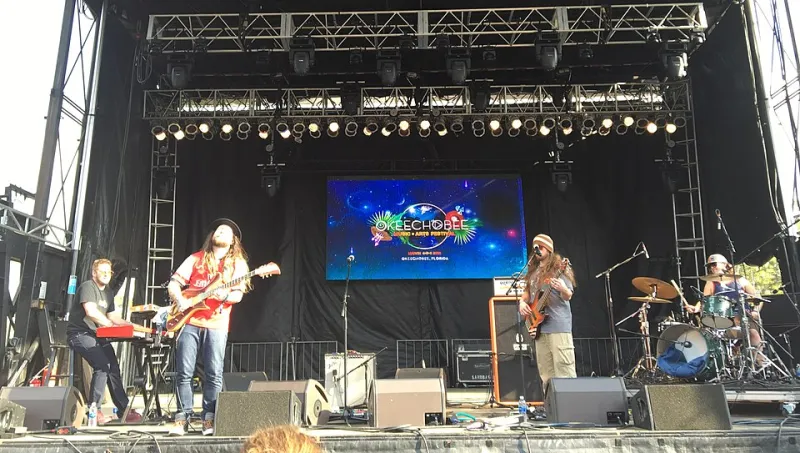
Photo: Shannon McGee, CC BY-SA 2.0, via Wikimedia Commons
There's a moment that happens at almost every jam band show. You've been waiting for it. Maybe you've been waiting for it for three tours. The band is deep into the second set, the room is loose and warm, and you feel it—that collective held breath right before someone in the crowd shouts the name of the song you drove four hundred miles to hear. And then the band pivots somewhere else entirely.
Sometimes you get the song. Sometimes you don't. And the thing is, both outcomes make sense if you understand what's actually happening up there.
The setlist conversation—who controls it, who influences it, and what gets sacrificed when those forces collide—is one of the most genuinely interesting dynamics in live music. Jam bands don't operate the way a pop act does, locked into a teleprompter-driven production where every note is predetermined. But they're not completely free agents either. There's a real, invisible negotiation happening every single night between the musicians on stage and the people standing in front of them.
The Crowd Knows More Than You Think
Fans of bands like Phish, Widespread Panic, or String Cheese Incident have been tracking setlists obsessively for decades. Websites, spreadsheets, Reddit threads, Discord servers—there is a whole infrastructure dedicated to cataloging what got played where, when, and in what configuration. Bands know this. They know their audience knows.
"You can feel when a room wants something specific," says one guitarist who's been touring the festival circuit for the better part of fifteen years. "It's not even about the requests people shout. It's the energy. The way people are moving, or not moving. There are nights when you can tell the crowd came loaded with expectations, and you have to decide whether to meet them or take them somewhere they didn't plan on going."
That tension—between delivering the familiar and chasing the unexpected—is baked into jam band culture at a foundational level. The whole appeal of the form is that no two shows are the same. But that ethos can create a weird kind of paradox: fans who love the band for their spontaneity also develop very strong opinions about what that spontaneity should look like.
Requests, Rituals, and the Art of Reading a Room
Every band has their version of the request story. A fan holding up a sign. Someone screaming the same song title between every song for two hours. A handwritten note passed to the stage manager. Some bands engage with this openly—dropping requests into the rotation as a kind of crowd service. Others treat it as background noise, something to acknowledge without letting it steer the ship.
"There's a version of playing requests that feels generous, and there's a version that feels like you're just doing karaoke of your own catalog," says a keyboardist who's spent years playing mid-sized theaters and outdoor festivals across the South and Midwest. "The best nights aren't when we played what people asked for. They're when we took the room somewhere nobody expected, and by the end, everybody felt like that was exactly what they needed."
Venue history plays into this more than most people realize. Bands often have a sense of what a particular room or city responds to—not just from memory, but from the data their most dedicated fans compile. Playing the same venue two nights in a row creates its own set of pressures. Repeat the same songs and people feel cheated. Go too deep into the vault and the casual fans who drove in for night two feel left out.
When Instinct and Expectation Collide
The real friction comes when the band's instincts point in one direction and the crowd's energy pulls hard in another. This happens more than bands usually admit publicly.
One touring bassist described a night at a mid-sized club in the Midwest where the crowd was clearly primed for a high-energy set—people were amped, the room was packed, drinks were flowing. But the band had just come off three brutal travel days, they were running on fumes, and the collective mood on stage was more introspective than explosive. "We went slow. We played weird. We went places that required people to really listen. And honestly? Half the room loved it and half the room didn't know what to do with it."
He pauses. "I still think it was the right call."
That kind of conviction—the willingness to trust the music over the moment's social pressure—is something you hear from seasoned tourers a lot. But it's not universal, and it's not always the right move either. There's a difference between artistic integrity and ignoring your audience, and the best bands spend years learning to tell those two things apart.
The Myth of Total Spontaneity
Here's something the jam world doesn't always talk about openly: most bands have more structure than the mythology suggests. There's usually a loose framework—a song or two locked in for the opener, maybe a closer that's been reliable for years, a handful of pieces that work as anchors when the improvisational stuff needs somewhere to land. The spontaneity happens inside that structure, not instead of it.
"People think we just walk out and whatever happens, happens," says one frontman who's been touring with the same core lineup for over a decade. "And there are nights that feel like that. But there's also a lot of quiet conversation in the van about what we haven't played lately, what's been working, what we want to try. It's not random. It's more like controlled chaos."
The crowd influences that pre-show conversation more than fans might expect. Bands pay attention to what people are posting online before a show, what the venue's regulars tend to respond to, what the local scene has been buzzing about. It's not pandering—it's information. The same way a good musician listens while they play, a good band listens before they even plug in.
Choosing the Music Over the Moment
Every serious touring musician has a story about the night they played something the crowd didn't want—and it turned out to be the best decision they made all tour. These are the moments that define a band's relationship with their own identity. It's easy to play the hits. It's easy to give people what they came for. The harder thing is trusting that what you have to offer is worth more than what the room is demanding.
That's not arrogance. It's faith in the music itself—the belief that if you play it honestly, the crowd will find their way to it. Sometimes they don't. Sometimes you lose the room. But sometimes you take three hundred people somewhere they didn't know they wanted to go, and that becomes the show they talk about for years.
The setlist, in the end, isn't really a list at all. It's a conversation. One that starts before the first note and doesn't end until the lights come up. And like any good conversation, the best ones are the ones where both sides are actually listening.